February 3, 2026
Why does the local government ban Airbnbs in the Netherlands?
12/4/2024
February 19, 2026
February 19, 2026

If you have searched for housing in the Netherlands, especially in cities like Amsterdam, Utrecht, or Haarlem, you’ve probably wondered this at some point. Why are Airbnbs restricted so heavily here? And why do local governments seem so strict about short-term rentals when housing is already so scarce?
From the outside, banning or limiting Airbnbs can feel counterintuitive. Tourists bring money. Homeowners earn extra income; if there are empty rooms, why not let them rent out? The reality is more complex, and for renters, the reasons behind these bans are directly connected to why finding a home has become so difficult.
The core issue isn’t tourism, it’s housing pressure
Local governments in the Netherlands don’t restrict Airbnbs because they dislike tourists. Tourism is economically important, and cities actively promote it. The real issue is housing availability.
In many Dutch cities, the housing supply is already under extreme pressure. There simply aren’t enough homes for the people who live, work, and study there. When residential properties are converted into short-term tourist accommodation, they disappear from the long-term rental market.
Each Airbnb isn’t just a holiday stay; it’s one less home. When this happens at scale, it directly worsens the housing shortage.
Short-term rentals compete with long-term renters
From a landlord’s perspective, short-term rentals can be far more profitable than long-term ones. Higher nightly rates, fewer tenant protections, and more flexibility make platforms like Airbnb attractive. But from a city’s perspective, this distorts the market.
Homes that would typically be rented to residents instead become mini-hotels. Entire buildings shift away from long-term housing. Renters are pushed out not because they can’t pay rent, but because they can’t compete with the economics of tourism. Local governments step in because the market no longer balances itself.
Neighborhoods change, and not always for the better
Another primary reason for Airbnb bans is the impact on neighborhoods. When short-term rentals cluster in residential areas, the character of those areas changes quickly. Neighbors rotate weekly. Noise complaints rise. Shared stairwells feel less safe. Local shops shift from serving residents to serving visitors.
For people who actually live there, this creates instability. Dutch cities place a high value on livable neighborhoods. When housing starts functioning like a hotel industry instead of a community, municipalities see that as a failure of policy, not a lifestyle choice.
Enforcement exists because voluntary limits didn’t work
In many cities, governments initially tried lighter approaches, such as registration systems, caps on rental days, or self-reporting rules. In practice, these systems were widely ignored or abused. Unregistered Airbnbs continued operating. Entire properties were rented out year-round despite limits. Enforcement lagged behind reality.
At that point, stricter bans weren’t ideological; they were reactive. Once a system becomes unenforceable, cities tend to simplify it. Explicit bans are easier to enforce than nuanced rules that rely on goodwill.
Why cities treat Airbnbs differently from hotels
A common argument is: Why allow hotels but ban Airbnbs? The answer lies in zoning and purpose. Hotels are built, licensed, and explicitly regulated for short-term stays. They’re located in designated areas, pay commercial taxes, and don’t remove housing from the residential stock.
Airbnbs usually operate within residential buildings that were never designed to serve as tourist accommodation.
From a planning perspective, these two things aren’t comparable, even if the end user experience feels similar.

The rental market impact is measurable
Local governments aren’t guessing when they say Airbnb affects housing availability. In cities where short-term rentals expanded rapidly, long-term rental supply dropped noticeably, especially in popular neighborhoods.
That drop doesn’t get reversed easily. Once a property is optimized for short-term use, it rarely returns to the long-term market unless regulations require it. The financial incentive just isn’t there. Bans are one of the few tools municipalities have to push homes back into residential use.
Why renters feel the effects first
Homeowners often see Airbnb restrictions as limiting personal freedom. Renters experience the consequences differently.
For renters, Airbnb growth usually means:
- Fewer available rentals
- Higher competition for the remaining homes
- Faster rent increases
- More temporary or unstable housing
When governments act, they are often responding to renter pressure, even if that connection isn’t always visible. Airbnb bans are less about tourism control and more about protecting access to housing.
The problem is worse in high-demand cities
Airbnb bans aren’t uniform across the Netherlands. They are strongest where housing pressure is highest. Cities with intense demand, limited space, and large tourist flows feel the impact first. Smaller towns or areas with surplus housing often have looser rules. This isn’t ideology, it’s triage. When a city is choosing between housing residents or hosting visitors, housing usually wins.
Bans don’t eliminate Airbnbs; they limit scale
Another misconception is that Airbnb completely removes short-term rentals. In reality, most Dutch cities still allow some form of short-term renting under strict conditions: limited duration, owner-occupancy requirements, registration, or permits.
The goal isn’t zero tourism rentals. It’s preventing professionalized short-term rental businesses from taking over residential housing. Occasional hosting is treated very differently from full-time operation.
Why governments intervene instead of “letting the market decide.”
In theory, markets balance supply and demand. In housing, especially in the Netherlands, that balance often fails. Housing is slow to build, heavily regulated, and essential for daily life. When demand spikes, prices rise quickly, but supply doesn’t catch up.
Short-term rentals amplify that imbalance. Local governments step in because housing isn’t just another commodity. It’s infrastructure. When access breaks down, the social consequences are severe.
What usually goes wrong in the public debate
The Airbnb discussion often becomes polarized. On one side, homeowners feel restricted. On the other hand, renters feel ignored. Tourists are blamed. Residents are frustrated.
What gets lost is that local governments are reacting to structural pressure, not picking sides. Airbnb bans aren’t anti-sharing. They’re pro-housing stability in a system that’s already stretched to its limits.
Does banning Airbnbs solve the housing crisis?
No, and governments are usually clear about that. Airbnb bans don’t magically create enough housing. They don’t replace years of underbuilding or fix affordability on their own.
What they do is stop the situation from getting worse. They protect the existing housing stock from permanent diversion from residents. In a crisis, prevention matters as much as solutions.
Why this matters even if you don’t use Airbnb
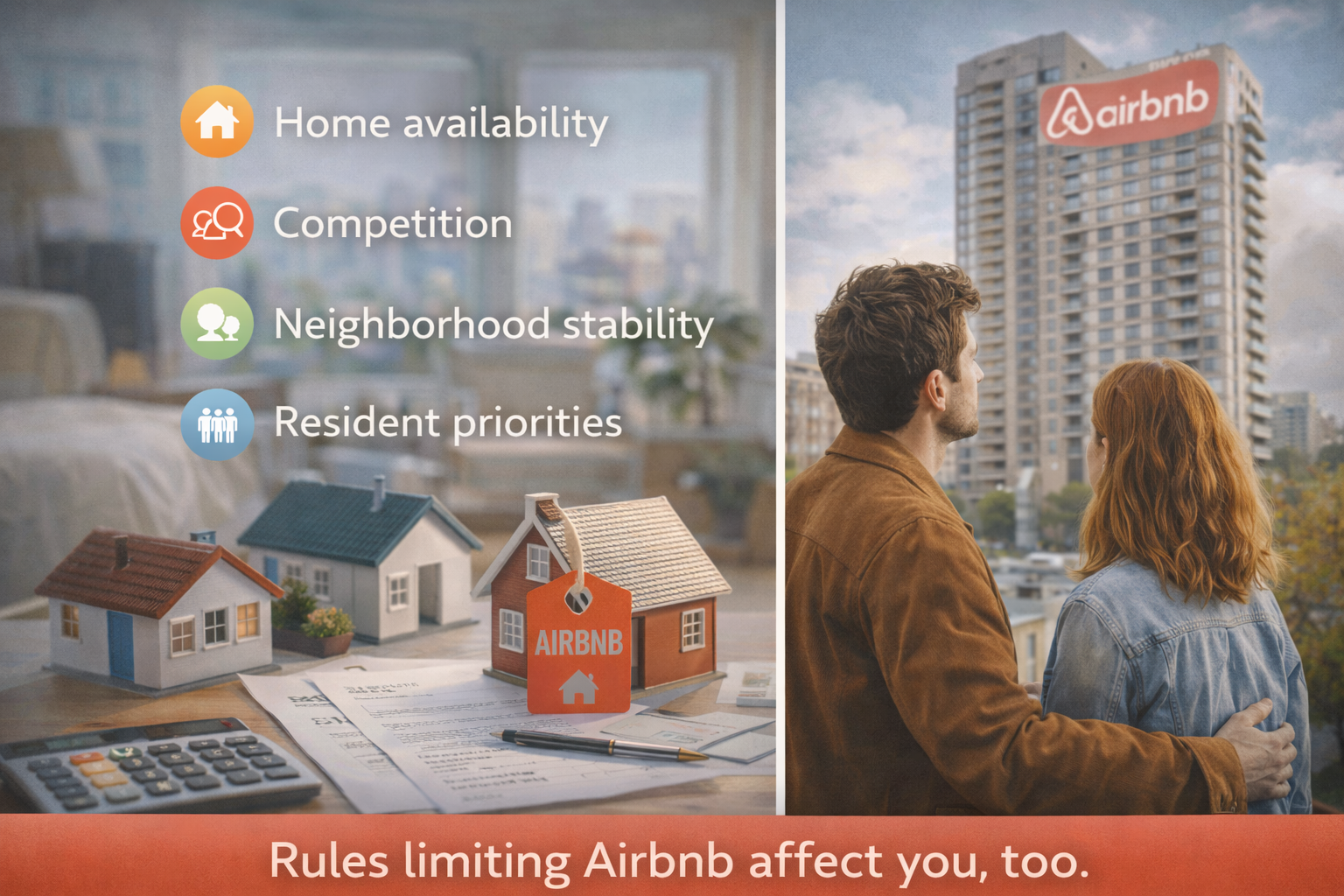
Even if you never plan to host or stay in an Airbnb, these rules affect you if you rent.
They influence:
- How many homes are available
- Where competition is most intense
- How stable neighborhoods remain
- How cities prioritize residents
Understanding this makes housing policy feel less abstract and more connected to daily life.
Understanding the Priorities of a Housing Crisis
Local governments ban or restrict Airbnbs in the Netherlands not because short-term rentals are inherently bad, but because housing scarcity forces hard choices.
When cities are full, demand is relentless, and renters are being pushed out, protecting residential housing becomes a priority, even if that limits certain freedoms.
Airbnb bans are a symptom of a deeper problem, not the cause. And until housing supply meaningfully catches up with demand, local governments will likely continue choosing homes for residents over rooms for visitors, not out of hostility, but out of necessity.