February 7, 2026
How do commute costs factor in?
18/8/2025
February 20, 2026
February 20, 2026
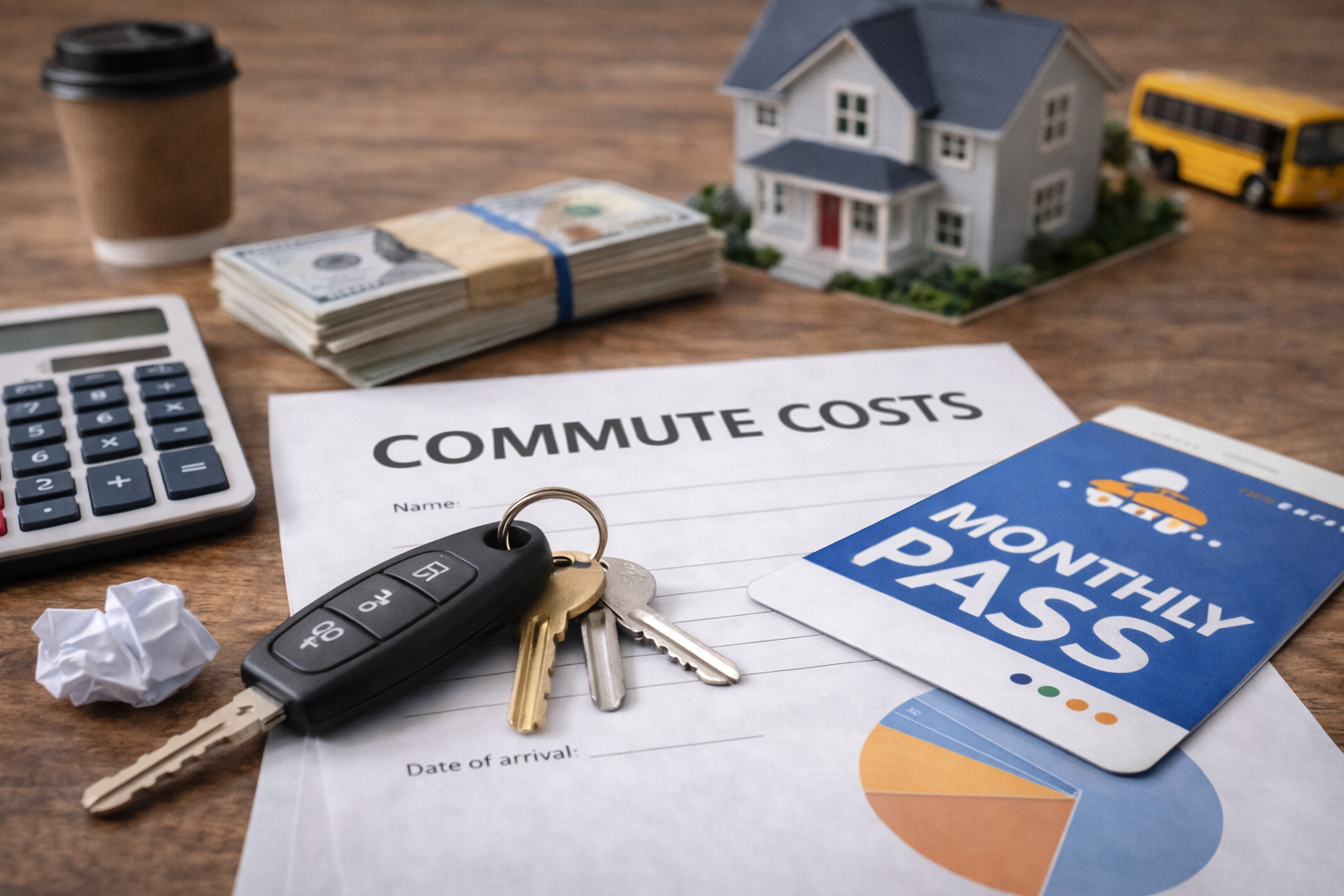
Commute costs are often treated as a separate category from housing, something you think about after you have already chosen where to live. During the housing search, attention tends to focus on rent, size, and availability, especially in a market where securing a place feels like an achievement in itself. What becomes clear only later is that commuting quietly reshapes monthly expenses and daily routines, turning location into a long-term financial decision rather than a purely practical one.
Distance turns time into money
The most obvious effect of commuting is time, but time quickly translates into cost. Longer commutes often require paid transport, fuel, or parking, and they also reduce flexibility around work and personal life. Even when public transport is efficient, longer distances usually mean higher subscription costs. What feels like a reasonable compromise at the start can become a persistent expense that quietly erodes the savings made on housing.
In the Netherlands, public transport pricing is strongly tied to how often you travel rather than how far you go on any single trip. Daily commuting amplifies these costs, especially when travel spans multiple zones or providers. While subscriptions reduce the price per journey, they still represent a fixed monthly commitment that needs to be paid regardless of how often you actually use them. This makes commuting costs feel unavoidable once routines are established.
Car commuting introduces layered expenses
Driving to work involves more than fuel. Parking fees, maintenance, insurance, and depreciation all become part of the commuting equation. In urban areas, parking alone can rival other household costs. These expenses are rarely calculated together, which makes car commuting seem cheaper than it is. Over time, the combination of small, regular payments creates a substantial monthly cost tied directly to where you live.
Cycling is often seen as the cheapest commuting option, and financially that is largely true. However, it still carries indirect costs. Bike maintenance, replacements, weather gear, and occasional public transport use during bad weather all add up. While these costs are lower than other options, they are not zero, and they increase with distance and frequency. The physical effort involved also influences how sustainable cycling feels over the long term.
Remote work changes but does not remove commute costs
Working from home reduces commuting frequency, but it does not eliminate commuting costs entirely. Hybrid arrangements still require regular travel, and subscriptions are often chosen to accommodate the maximum number of days rather than actual usage. In addition, working from home shifts costs elsewhere, such as higher energy consumption. The financial impact of commuting becomes less visible, but it remains part of the overall cost of working.
Lower rent in a more distant area often comes with higher commuting costs. These trade-offs are rarely compared directly during the housing search. People tend to focus on immediate, visible savings rather than ongoing expenses that feel secondary. Over time, commuting can absorb much of the financial advantage gained by choosing a cheaper location, especially when travel is required five days a week.

Peak-hour travel limits flexibility
Commuting during peak hours reduces the ability to optimize costs. Off-peak discounts, flexible routes, or alternative modes are less accessible when work schedules are fixed. This rigidity turns commuting into a fixed expense rather than one that can be adjusted month to month. The lack of flexibility is often more costly than the distance itself.
Commutes affect daily spending patterns
Longer commutes influence spending beyond transport. Eating out, convenience purchases, and occasional taxis become more common when time is limited. These secondary costs are rarely attributed to commuting, yet they are directly linked to the length and structure of the journey. Over time, they form part of the hidden cost of living further from work.
Changes in work location create financial friction
When work locations change, commuting costs can shift dramatically. A move to a different office or a new job can turn a manageable commute into an expensive one without any change in housing. This vulnerability is part of the long-term risk of choosing housing primarily based on current commuting needs. Flexibility in housing often matters as much as affordability.
During moves, job changes, or family adjustments, commuting costs become more noticeable. New routes, subscriptions, and routines require setup and experimentation, often at higher cost. These transitional periods highlight how embedded commuting expenses are in daily life and how quickly they can add pressure to budgets.
The psychological weight of commuting
Beyond money, commuting carries a psychological cost that influences how expenses are experienced. Long or difficult commutes make financial trade-offs feel heavier, even when the numbers are reasonable. This emotional layer often leads people to reassess housing decisions later, once the daily reality of travel becomes clear.
Unlike rent, commuting costs do not arrive as a single bill. They appear through subscriptions, fuel, parking, and incidental expenses. Because they are spread across categories, they are easy to underestimate. Over a year, however, they often rival other major household costs, reshaping the true affordability of a home.
Location decisions lock in commuting patterns
Housing choices tend to be long-term, while work arrangements change more frequently. This mismatch means that commuting costs can become fixed even when the reasons for them disappear. Once routines are established, they are difficult to unwind without another move, which carries its own costs and risks.
Seeing commuting as part of housing affordability
Commute costs are not an add-on to housing; they are a direct consequence of where you live relative to where you need to be. When they are viewed alongside rent or mortgage payments, the financial picture becomes clearer. A cheaper home with higher commute costs may be no cheaper at all over time.
Recognizing how commuting shapes budgets does not change distances or prices, but it reframes expectations. The strain often comes from discovering these costs after the move rather than from the costs themselves. When commuting is understood as part of the housing decision, its impact feels less like a surprise and more like a known trade-off in daily life.