February 7, 2026
How do energy costs vary by type of home?
12/4/2023
February 7, 2026
February 7, 2026

In 2026, a home's energy consumption became one of the most decisive factors for total housing costs. Where we used to mainly look at rent or mortgage, current market conditions force us to take a building's “energy footprint” seriously. Although energy costs in the Netherlands have stabilized after the turbulent twenties, the difference between a compact apartment and a detached villa is greater than ever. This is not only due to the volume that needs to be heated, but also to the exposure to the elements and the architectural efficiency.
Those looking for a new home in 2026 should understand that the type of building is often a more direct predictor of energy bills than the number of residents. In this article, we analyse the variations in energy costs by home type and look at the factors that drive these differences.
Apartments: The efficiency of shared walls
Apartments will generally be the most energy efficient in 2026. The main reason for this is the limited surface area of exterior walls. An apartment is surrounded on several sides by other heated areas, which act as a natural insulation layer.
- Intermediate apartments: A house on a middle floor benefits from the warmth of the lower and upper neighbours. In 2026, the average gas consumption for a modern apartment will be around 500 to 700 m³ per year, resulting in monthly costs of around €120 to €150 (including electricity).
- Corner apartments and upstairs apartments: These types have more contact with the outside air or the roof, so that consumption can be up to 20% higher than an intermediate apartment. Especially in older apartment complexes, roof insulation will be a crucial factor for residents on the top floor in 2026.
Bungalows: The balance between space and insulation
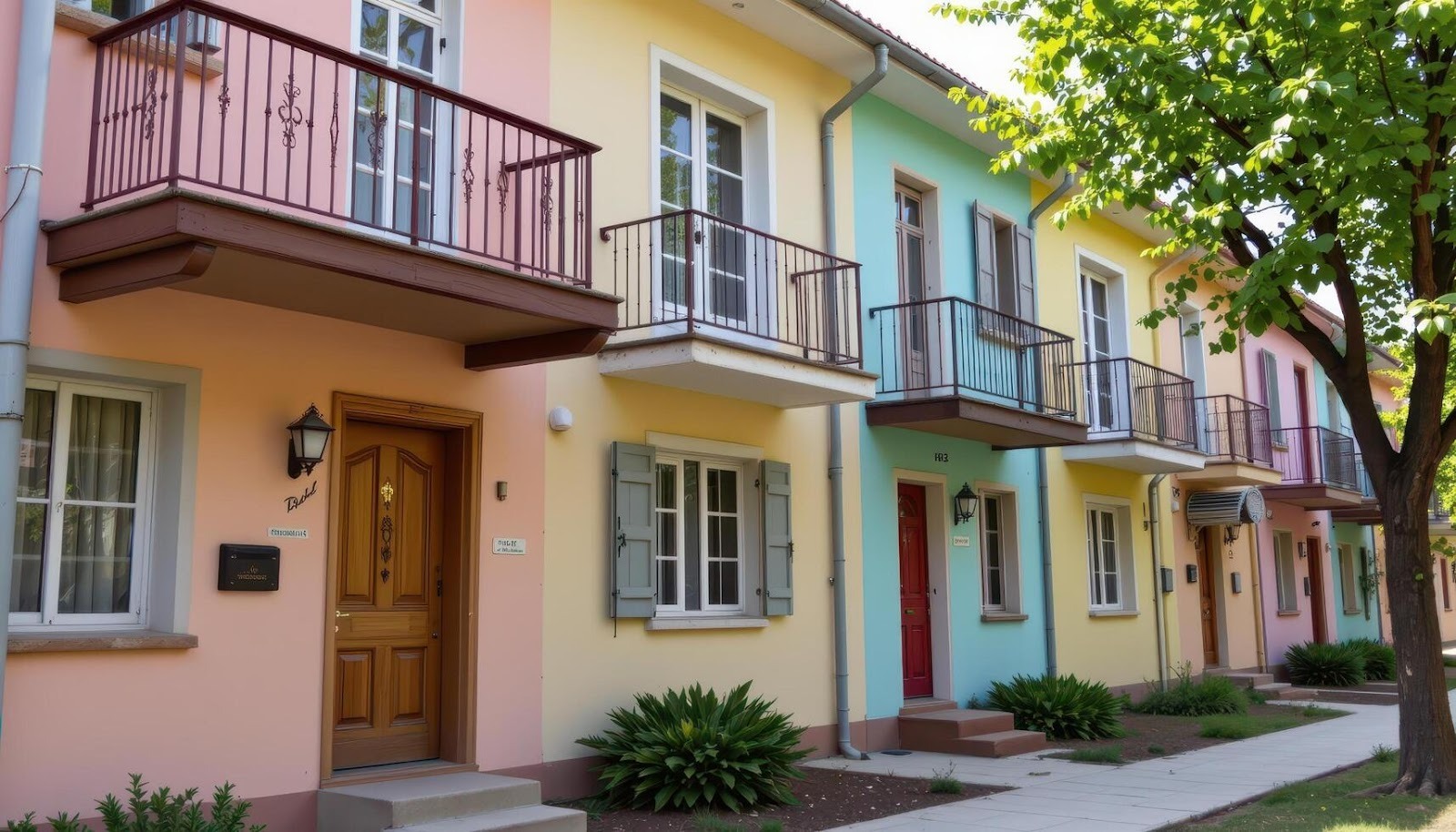
The classic Dutch townhouse offers an excellent balance for families. Because only the front and rear facades are directly adjacent to the outside air, heat loss remains limited.
In 2026, we will see that semi-detached houses with an energy label A or higher will often switch to hybrid heat pumps. For an average townhouse with three residents, you should expect an annual consumption of approximately 1,000 to 1,200 m³ of gas (or the equivalent in heat). The monthly bill for such a home will fluctuate around €190 to €230 in 2026. However, the difference between a 1930 townhouse and a 2020 new-build home is gigantic; the older home can easily consume 50% more without thorough renovation due to drafts and inadequate cavity insulation.
Corner house and semi-detached house: The impact of the side wall
As soon as a home has an extra exterior wall, such as a corner house or a semi-detached house, energy costs rise immediately. The additional side wall acts as a large cooling surface in the winter.
- Heat loss: On average, a corner house loses 15% to 25% more energy than an identical townhouse in the same street. In 2026, this will translate into a monthly additional item of approximately €30 to €50.
- Solar potential: On the plus side, these homes often have a larger roof area that is not shared with neighbours, so there is more space for solar panels. In 2026, the “payback period” of additional insulation on the side wall is one of the most profitable investments for this type of homeowners.
Detached houses: The price of independence
In 2026, the detached house will be the most challenging type of home in terms of energy costs. With no neighboring neighbors, the house is exposed to wind and cold on all sides. In addition, detached houses are often larger, which means that more cubic meters of air simply need to be heated.
For an average detached home, consumption will often exceed 1,800 m³ of gas per year in 2026, unless far-reaching sustainability measures have been taken. Monthly payments of €350 to €450 are no exception here. For buyers in this segment, the energy label became almost as important as the asking price itself in 2026; in the long run, a label G home can be tens of thousands of euros more expensive than a label A++ home.
The role of the year of construction and energy label
Although the type of house lays the foundation, the condition of the home determines the final result on the meter. In 2026, the distinction between “old buildings” and “new buildings” will be sharper than ever before.
- New construction (after 2015): Regardless of the type (apartment or detached), these homes are often gas-free and equipped with heat pumps and balance ventilation. The energy costs here are predictably low and are often largely covered by own solar energy.
- Historic construction (before 1975): Without cavity insulation or double glazing, these homes are energy guzzlers. In 2026, we will see that the market value of these types of homes is directly linked to the insulation package that is still to be implemented.
Choosing strategically for the future
When choosing a home, it is essential to see energy costs as an integral part of the monthly costs. In 2026, the trend is clear: compact and connected living will be fiscally and economically rewarded by lower energy requirements. However, due to the rise of affordable insulation materials and more efficient heat pumps, detached homes can also come close to apartment consumption, provided that the investment is made.
The variation in energy costs per home type reminds us that we not only pay for the space in which we live, but also for how that space combats the outdoor climate.